
If you’ve spent any time in New York City, you know the bodega egg. You’ve probably stood at a deli counter at 7am watching someone work a flat-top griddle with the kind of quiet efficiency that only comes from making the same thing a few hundred times. Eggs cracked onto the griddle, cheese laid on while they’re still wet, folded into a roll that’s been sitting face-down on the same griddle getting toasted in whatever fat is left over. The whole thing takes about ninety seconds and costs four dollars and tastes better than eggs you’ve spent twenty minutes making at home.
That gap — between the bodega egg and the home egg — isn’t about ingredients. The eggs are the same eggs. The cheese is usually American, which you can buy anywhere. The roll is a Kaiser or a hero, nothing special. The gap is almost entirely technique, and once you understand what’s actually happening on that flat-top, you can close it.

What makes a bodega egg different
The bodega egg is not a fried egg. It’s not a scrambled egg. It’s its own thing — a specific hybrid that comes from cooking on a flat-top griddle at high heat with very little ceremony.
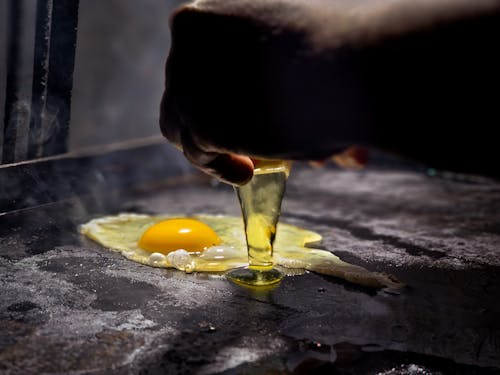
The egg goes onto a hot, lightly greased surface and is immediately broken up and spread slightly — not scrambled into small curds like diner eggs, but pushed into a rough oval shape that matches the bread. The yolk is broken and mixed into the white, but only just. The result is something between a fried egg and a scrambled egg: a single flat patty with some texture variation, slightly crispy on the bottom where it’s in contact with the griddle, just set on top.
The cheese goes on while the egg is still wet — before it’s fully cooked. This is important. The residual heat from the egg and the griddle melts the cheese from below while the top of the egg finishes setting, so by the time the egg is done, the cheese is fully melted and integrated rather than sitting on top like an afterthought. American cheese is traditional and functional — it melts at a lower temperature than almost anything else and does so evenly, which is why it works here even if it’s not fashionable.
The bread goes face-down on the griddle at some point during all of this — toasting in whatever butter or oil is on the surface, picking up color and a slight crispness that keeps it from going immediately soggy when the egg goes in.
Everything comes together fast, at high heat, with confidence. That last part isn’t nothing.
The flat-top and what it does
Most home cooks use a nonstick pan, which is fine for eggs but produces a fundamentally different result from a flat-top griddle. The differences matter.
A flat-top runs hotter and holds heat more evenly than a home pan. The large surface area means the egg spreads out on contact and cooks quickly from below, setting the bottom before the top has fully cooked — which is what gives a bodega egg that slight textural contrast between a crispy underside and a softer top. A nonstick pan at medium heat cooks the egg more gently and more evenly, which is great for French scrambled eggs and not what you’re going for here.
The accumulated seasoning on a well-used flat-top also contributes. A bodega griddle has cooked thousands of eggs, sausages, bacon, and sandwiches — the surface has a layer of polymerized fat that adds flavor in the same way a cast iron pan does, only more so. You can approximate this at home with a cast iron skillet or a carbon steel pan, both of which hold heat better than nonstick and develop seasoning over time.
The other thing a flat-top does is give you space — room to toast the bread on the same surface as the egg, at the same time, without juggling two pans. At home, this means either using a large cast iron that fits both, or accepting that the bread gets done in a toaster and the griddle flavor on it is lost. Not a dealbreaker, but worth knowing.
How to do it at home
The goal is to replicate the heat, the speed, and the sequence. Here’s how each element works.
The pan. Cast iron or carbon steel, preheated over medium-high heat for at least two minutes before anything goes in. You want the surface genuinely hot — a drop of water should evaporate almost immediately on contact. A nonstick pan on high heat works in a pinch, but don’t push nonstick above medium-high or you risk damaging the coating.
The fat. A small amount of butter, allowed to melt and just start to foam before the egg goes in. Some bodegas use a neutral oil, some use butter, some use whatever’s left on the griddle from the last thing cooked. Butter gives you better flavor and a slightly more golden underside. Don’t use too much — you want the egg to cook in contact with the pan surface, not float in fat.
The egg. Crack it directly onto the hot surface. Immediately break the yolk with the edge of the spatula and spread the egg slightly into a rough oval — wide enough to cover the bread you’re using. You’re not scrambling it aggressively, just breaking the yolk and nudging the egg into shape. Two eggs work better than one — they give you more coverage and more structure in the finished sandwich.
The cheese. American cheese goes on while the egg is still visibly wet on top — about 30 to 45 seconds in, depending on your heat. Lay it directly on the egg and leave it. The heat from below will melt it. If it’s not melting fast enough, you can place a lid or a piece of foil over the pan for 20 seconds to trap steam and help it along. Don’t flip the egg. Bodega eggs don’t get flipped.
The bread. A Kaiser roll, split and placed face-down in the pan alongside the egg — or in a separate dry pan, or in a toaster if you’re not working with a large enough surface. The inside of the roll should be golden and slightly crisp. This step is not optional. A soft, untoasted roll goes soggy within thirty seconds of the egg going in and the structural integrity of the sandwich collapses.
The assembly. When the egg is set on top and the cheese is melted, slide the spatula under the whole thing and fold it in half — or fold the edges in to match the shape of the roll — and place it on the bottom half of the bread. Top half goes on. Press down gently. Eat immediately.
The bodega sauce situation
A proper bodega egg sandwich has a sauce, and the sauce is not ketchup, even though a lot of people use ketchup. The classic is a combination of butter that’s been on the griddle and whatever condiments are on the counter — but at home, the version that gets closest to the real thing is either hot sauce (Crystal or Cholula, not Tabasco, which is too sharp), or a simple combination of mayo and hot sauce mixed together and spread on the inside of the roll before assembly.
Some bodegas use a specific seasoning salt on the eggs as they cook — Lawry’s or a similar all-purpose blend — rather than straight salt and pepper. It sounds like a small thing and it’s not. The seasoning salt adds a slight sweetness and depth that straight salt doesn’t. If you want to get close to the specific flavor profile of a New York bodega egg, a pinch of seasoning salt on the egg as it cooks is worth trying.
Salt and pepper in addition to, not instead of, the seasoning salt. The egg needs proper seasoning and it needs it while it’s cooking, not after — eggs seasoned after cooking taste flat compared to eggs seasoned on the heat.
What to add and what not to add
The bodega egg is a study in restraint. The best versions have egg, cheese, bread, and maybe one additional element — bacon, sausage, or avocado if the bodega is feeling progressive. The worst versions are the ones that turn into a breakfast burrito on a roll, where so many things are added that the egg itself becomes irrelevant.
Bacon or breakfast sausage cooked on the same surface as the egg, then folded in with the cheese, is the natural addition. Taylor ham — pork roll, for anyone outside the New York/New Jersey area — is the regional addition that turns it into something slightly different and equally worth knowing about. Avocado, if it’s ripe, works because it adds fat and creaminess without competing with the egg.
What doesn’t belong: vegetables that need cooking time, runny sauces that soak the bread, anything that requires a separate pan and five extra minutes. The bodega egg is fast food in the original sense — food that is made fast, eaten fast, and is better for it. Adding complexity to it tends to miss the point.
Why it tastes better at the bodega
Even if you do everything right, your home version will be slightly different from the one at the counter on the corner. Some of that is the pan seasoning and the flat-top heat. Some of it is the specific roll — a bodega Kaiser has a texture and density that comes from a commercial bakery that makes thousands of them a week, and it’s different from a supermarket Kaiser even if they look the same.
But most of it is something less tangible: the bodega egg tastes like what it is. It tastes like a city morning, eaten standing up or on the subway, wrapped in foil that steams the bread slightly as you carry it. Context is a flavor. You can make an excellent version at home — Millie’s technique gets you very close — but the full experience involves a certain amount of New York, and that part doesn’t travel.
What does travel is the method. High heat, fast cook, cheese on while it’s still wet, toasted bread, confidence with the spatula. Get those right and the home version is genuinely excellent, even if it’s eaten at a kitchen table rather than a subway platform.
The one thing most people get wrong
Low heat. That’s it. That’s the mistake.
Home cooks are taught to cook eggs gently — low heat, slow scramble, don’t rush it. That’s the right lesson for French scrambled eggs and completely wrong for a bodega egg. The bodega egg needs high heat to set the bottom quickly, to create that slight crispness on the underside, to melt the cheese fast without overcooking the top of the egg.
If you cook a bodega egg on medium-low heat, you get a pale, soft, slightly rubbery egg that tastes like it was cooked in a hotel. If you cook it on medium-high in a properly preheated pan, you get a golden-bottomed, cheese-pulled, slightly crispy-edged egg that tastes like it came off a flat-top that’s been running since five in the morning.
Turn the heat up. Move fast. Don’t overthink it. That’s the whole secret.
Here is the recipe for the Bodega style egg sandwich.
MORE EGG RECIPES
- Classic Quiche Lorraine
- Easy Breakfast Quesadillas
- Mexican Chorizo And Egg Tacos
- Vegetarian Migos Tacos
- Crispy Creamy Egg Boats
BODEGA STYLE EGG SANDWICH

This bodega style egg sandwich is a delicious, NYC breakfast that’s ready in less than 20 minutes.
- Prep Time: 5 minutes
- Cook Time: 7 minutes
- Total Time: 12 minutes
- Yield: Serves 1
- Category: Breakfast
- Cuisine: American
Ingredients
1 English muffin, split
2 tablespoons butter
1 extra-large egg
½ teaspoon water
Salt and pepper to taste
3 slices bacon, cooked crisp
1 slice cheese (I used Velveeta Slices)
Instructions
Lightly toast the English muffin.
Spread 1 tablespoon of butter on each half.
In a small bowl, beat the egg with the water until pale in color and you no longer see streaks of the whites of the egg.
In a non-stick skillet over medium-high heat, melt the remaining 1 tablespoon of butter.
Pour in the egg and roll it around so that it coats the bottom of the pan.
Sprinkle it with salt and pepper.
Use a rubber or wooden spatula to lift the edges of the egg and allow the raw egg to run underneath.
Allow the egg to cook for about a minute until set, but still looks moist on top.
With the spatula, fold the edges of the egg into the center to create a square.
Place the cheese slice on the egg square and allow to cook for another minute.
Meanwhile, place the cooked bacon on the bottom half of the buttered English muffin.
Slide the egg square on top of the bacon and top with the other half of the English muffin.
Serve immediately.